


Short overview
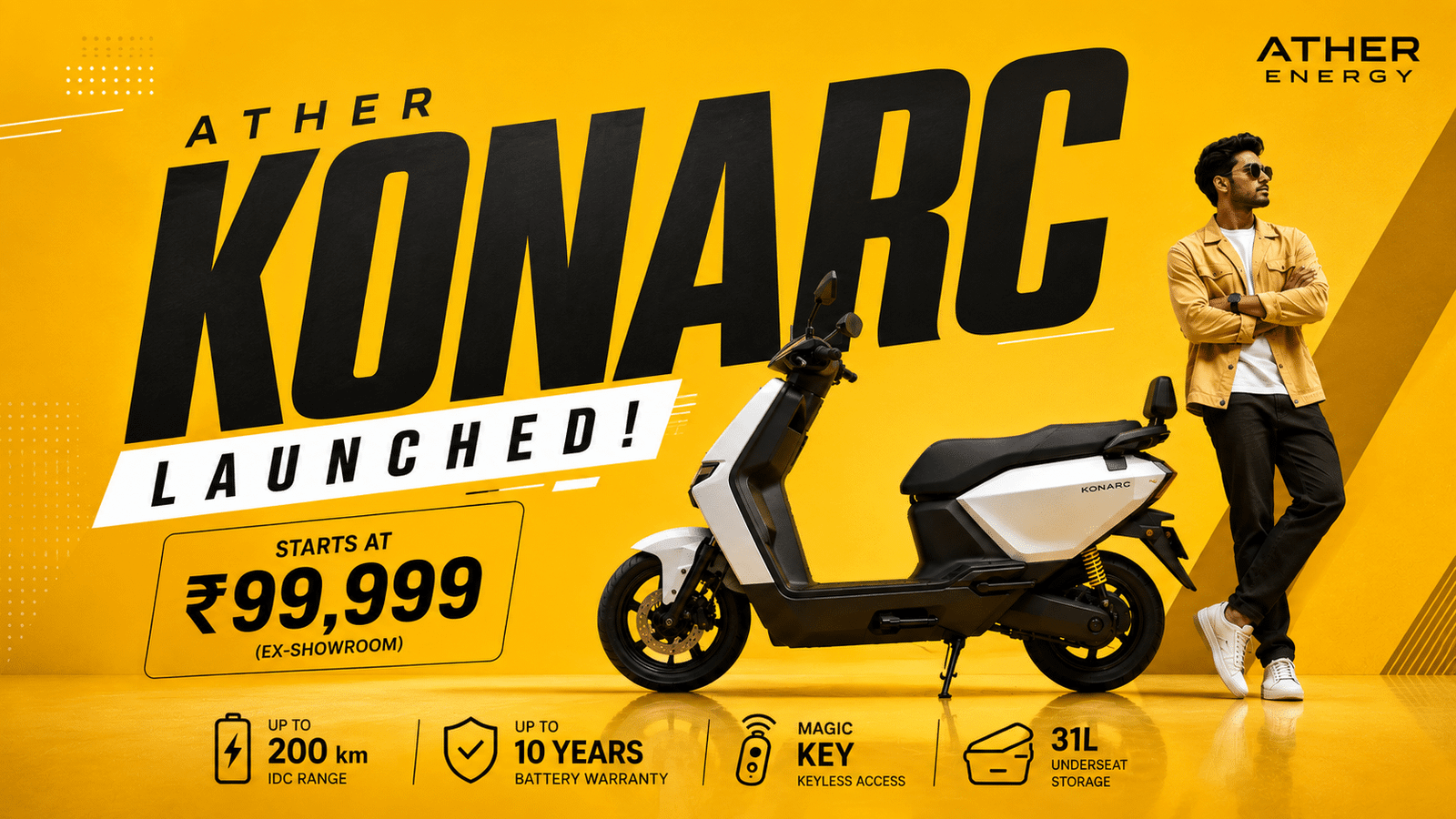
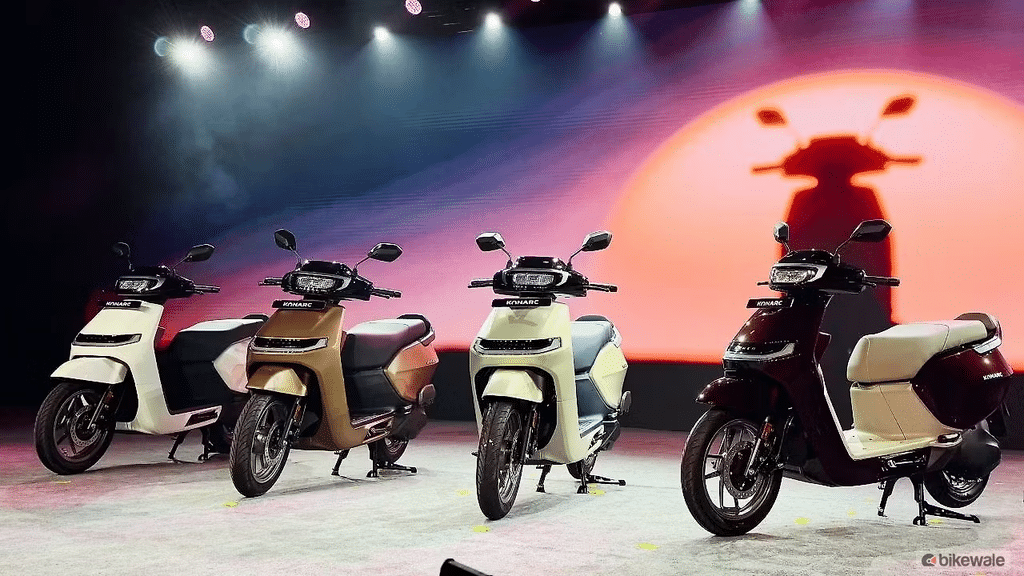
The Ather Konarc is a new electric scooter from Bengaluru-based EV manufacturer Ather Energy, introduced in August 2026. Designed around everyday usability, it combines a metal body, a steel unibody chassis, practical storage, modern connectivity and multiple battery options. The Konarc S lineup includes models with claimed IDC ranges of 100 km, 125 km and 161 km, while a 200 km version is planned. The company has also announced higher-feature Konarc Z variants. With prices starting at ₹99,999 ex-showroom for the S 100 variant, the Konarc aims to make electric mobility accessible to more Indian commuters.
Introduction to the Ather Konarc electric scooter
India’s electric two-wheeler market is growing as more people look for affordable, convenient and energy-efficient ways to travel. Rising petrol expenses, busy city roads and increasing interest in cleaner transportation are encouraging buyers to explore electric scooters for their everyday journeys.
One of the latest additions to this market is the Ather Konarc electric scooter. Launched by Ather Energy in August 2026, the Konarc introduces a new platform called EL and focuses on practical features that matter to everyday riders. Its combination of a metal body, long-travel suspension, modern dashboard technology and useful storage makes it an interesting option for commuters and families.
Unlike a scooter designed only around sporty performance, the Konarc places considerable attention on daily comfort, convenience and ease of ownership. It also comes with different battery capacities and range options, allowing buyers to consider a model based on their regular travel requirements.
However, choosing an electric scooter involves more than checking its advertised range or starting price. Charging facilities, real-world riding distance, warranty conditions, local service availability and the final on-road cost also deserve attention.
This guide explains the Ather Konarc’s price, specifications, features, charging options and ownership considerations to help potential buyers make a better-informed decision.
Ather Konarc price in India and variants
Price is often the first thing people check when considering an electric scooter. Ather has positioned the Konarc with a starting price intended to attract a wider range of buyers.
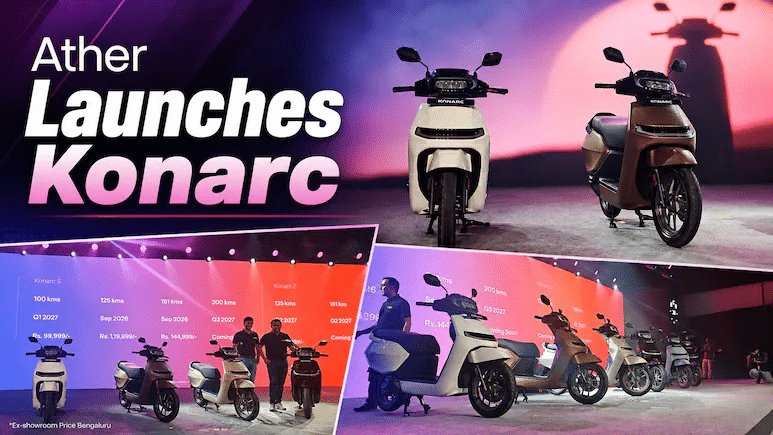
According to published launch information, the Ather Konarc S 100 is priced at ₹99,999 ex-showroom in Bengaluru. The S 125 is priced at ₹1,21,999, while the S 161 costs ₹1,44,999 ex-showroom. Prices and availability can vary by location and may change over time, so buyers should verify the latest figures with Ather before making a booking.
| Variant | Claimed IDC range | Launch ex-showroom price |
| Konarc S 100 | 100 km | ₹99,999 |
| Konarc S 125 | 125 km | ₹1,21,999 |
| Konarc S 161 | 161 km | ₹1,44,999 |
| Konarc S 200 | 200 km | Price to be confirmed |
| Konarc Z 125 | 125 km | Price to be confirmed |
| Konarc Z 161 | 161 km | Price to be confirmed |
Source: Ather launch and FAQ information. The S 200 and Z variants have been announced as planned models; availability and pricing should be confirmed with the manufacturer. The published starting price refers to ex-showroom Bengaluru pricing, not the final on-road cost.
The Konarc S 100 may appeal to people with shorter daily commutes who want a lower initial purchase price. The S 125 provides a middle option for riders who need additional range, while the S 161 offers a larger battery and a higher claimed riding range.
The upcoming 200 km version could attract riders who regularly travel longer distances. However, it is important to distinguish announced specifications from models that are currently available for purchase.
Before selecting a variant, compare the ex-showroom price with the final on-road price, including registration, insurance, accessories and any applicable state-level benefits.
Battery, riding range and charging options
Battery capacity and riding range are two of the most important factors when buying an electric scooter. The Konarc lineup offers different battery sizes to suit different travel requirements.
According to Ather’s published specifications, the S 100 uses a 2.1 kWh battery, the S 125 uses a 2.7 kWh battery and the S 161 uses a 3.5 kWh battery. The listed IDC ranges are 100 km, 125 km and 161 km, respectively. Ather also publishes lower TrueRange figures for these versions, reflecting a different range measure.
This difference matters because the distance a scooter covers in everyday conditions may be lower than its certified test-cycle figure. Traffic, riding speed, passenger weight, road gradients, tyre pressure and weather can all influence energy consumption.
For example, a person who travels around 20–30 km each day may find a mid-range version suitable, depending on their charging access and actual riding conditions. Someone covering longer distances may prefer a larger battery to maintain a comfortable reserve.
The scooter includes a 450W onboard charger. Ather’s published specifications list approximate home-charging times from zero to 80% of four hours for the 2.1 kWh version, four hours and 30 minutes for the 2.7 kWh version, and five hours and 40 minutes for the 3.5 kWh version. An additional charger can support combined charging on compatible configurations.
Ather also provides access to its Grid charging network, subject to variant eligibility and availability. The manufacturer advertises charging-related range gains of up to 15 km in 10 minutes for certain configurations. Actual charging performance depends on the scooter, charger, battery condition and charging conditions.
For most commuters, the practical question is simple: can the scooter cover the day’s travel and recharge conveniently overnight? Answering that question is more useful than choosing a model based on its maximum advertised range alone.
7. Design, comfort and everyday practicality
The Ather Konarc uses a metal body and steel unibody chassis, giving it a different construction approach from scooters that rely more heavily on plastic exterior panels. The design focuses on durability and the demands of regular urban use.
The scooter also features a 14-inch front alloy wheel and long-travel suspension. These elements are intended to support stability and comfort on everyday roads, where potholes, uneven surfaces and speed breakers are common. The actual ride experience will depend on road conditions, tyre pressure, rider weight and suspension tuning.
Storage is another useful part of the Konarc package. The scooter offers 31 litres of underseat storage, along with a separate front storage compartment. That space can be useful for carrying shopping bags, a raincoat, work essentials and other daily items. The company also lists a mobile holder with USB charging support, with some accessories dependent on the selected variant.
These details make the scooter relevant to working professionals, students and families who want a vehicle for more than a short solo commute. Nevertheless, buyers should test the seat height, handlebar position, floorboard space and overall weight before purchasing.
A test ride is particularly helpful for people who regularly carry a passenger or ride through congested roads.
8. Smart features and safety technology
Modern electric scooters are becoming more connected, and the Konarc reflects this shift. Depending on the variant, the scooter offers a dashboard with connected functions, riding information and smartphone-related features.
The listed technology includes navigation, riding modes, reverse assistance, vehicle-location functions, remote charging-status information and alerts. Higher-feature variants add more convenience and assistance features, although equipment is not identical
The scooter’s AutoHold feature is designed to help keep it stationary on slopes, reducing the need to continuously apply the brake lever in supported configurations. AirWalk assists with manually moving the scooter by providing motor assistance when the rider pushes or pulls it. This can be useful in tight parking spaces, though riders should understand the operating instructions before relying on either feature.
Ather also lists Vehicle FallSafe on selected variants. Feature availability varies, so buyers should confirm which technologies are included with the exact model they intend to purchase.
The Z line has been associated with additional technology, including an Advanced Electronic Braking System and expanded dashboard connectivity. These features should not be assumed to be standard across all S variants.
Technology can make everyday riding more convenient, but it does not replace safe riding habits. Riders should continue to wear a suitable helmet, maintain a safe following distance and use the scooter within its intended operating limits.

9. Ather Konarc specifications at a glance
The following table summarises key details published for the Konarc S variants.
| Specification | S 100 | S 125 | S 161 |
| Battery capacity | 2.1 kWh | 2.7 kWh | 3.5 kWh |
| Claimed IDC range | 100 km | 125 km | 161 km |
| Published TrueRange | 80 km | 100 km | 130 km |
| Top speed | 70 km/h | 70 km/h | 70 km/h |
| Peak power | 4 kW | 4.7 kW | 4.7 kW |
| Maximum torque | 16 Nm | 16 Nm | 16 Nm |
| Motor protection | IP67 | IP67 | IP67 |
| Onboard charger | 450W | 450W | 450W |
Source: Ather’s official Konarc specifications. Figures refer to the listed S configurations and should be checked against the latest model information before purchase.
These figures show that the range options are primarily differentiated by battery capacity, while motor output also varies on the entry-level version. The 70 km/h listed top speed makes the S range more relevant to ordinary commuting than to buyers seeking high-speed performance.
For buyers, the best variant is not necessarily the one with the largest battery. It is the one that provides enough usable range for daily travel without creating unnecessary upfront expense.
10. Battery warranty, maintenance and ownership costs
One of the most important parts of electric scooter ownership is understanding the battery warranty and the maintenance requirements. The purchase price is only one part of the total cost; charging, tyres, insurance, servicing and possible repairs also affect long-term expenses.
Ather lists a standard battery warranty of three years or 30,000 km, whichever comes first. Its FAQ also describes an AtherStack Pro upgrade that extends battery coverage to five years or 60,000 km on eligible terms. Additional extended battery warranty options are listed for eight years or 80,000 km and ten years or 100,000 km, subject to the applicable conditions and charges. Buyers should review the written warranty terms for their specific scooter before booking.
Ather also promotes a service interval of once every 12 months or 10,000 km, whichever comes first. This can make scheduled maintenance more convenient for owners, although tyres, brakes and other wear items may need attention sooner depending on use.
Charging at home may cost less than buying petrol for a comparable daily commute, but the actual saving depends on electricity tariffs, vehicle efficiency and the petrol scooter being used for comparison. Public charging fees, if applicable, should also be included in the calculation.
A simple way to compare costs is to estimate your monthly kilometres, your local electricity rate and the scooter’s actual energy consumption. Then compare that figure with the fuel expenses and regular maintenance costs of your current vehicle.
Do not assume that every electric scooter automatically saves the same amount. The benefit depends on how much you ride, where you charge and how long you plan to keep the vehicle.
11. Who should consider buying the Ather Konarc?
The Ather Konarc could be worth considering for people who want an electric scooter for regular city travel. Office commuters, students, small families and riders who frequently run local errands may appreciate its storage, connected features and different battery options.
It may also suit existing petrol-scooter owners who want to reduce their dependence on fuel and have access to convenient charging. People who park at home overnight and travel predictable daily distances are often in a good position to benefit from electric mobility.
However, the Konarc may not be the right choice for everyone. Buyers who regularly travel beyond the available range, lack reliable charging access or need a vehicle for frequent high-speed highway journeys should assess their requirements carefully.
It is also worth comparing the Konarc with other electric scooters in the same price range. Look at the final on-road price, real-world range, seat comfort, service centre availability, warranty coverage and features included as standard.
The best buying decision comes from matching the scooter to your lifestyle rather than choosing it simply because it has a new design or an impressive specification sheet.
12. Things to check before booking
Before paying a booking amount, visit an authorised Ather Experience Centre and take a test ride if available. Check whether the preferred variant and colour are being sold in your city, as announced models may not be available everywhere at the same time.
Ask for a complete written price breakdown that includes insurance, registration, accessories and any applicable offers. Confirm the battery warranty, charging equipment included with the scooter and the cost of any optional connected services.
It is equally important to check charging arrangements at your home or apartment. If you live in a shared building, confirm that you have permission to install or use a suitable charging point. If you expect to depend on public chargers, check their location and availability along your regular routes.
Finally, ask the dealer about delivery timelines, cancellation terms and service support in your area. These practical checks can help you avoid surprises after booking.
14. Conclusion: Is the Ather Konarc worth considering in 2026?
The Ather Konarc electric scooter brings together a practical design, multiple battery options, modern technology and everyday convenience. Its metal body, steel unibody chassis, 31-litre storage capacity and range choices make it an interesting addition to India’s electric two-wheeler market.
Its biggest attraction is the range of options available to different types of commuters. Buyers with shorter journeys can consider the lower-priced version, while those who travel further may prefer a higher-capacity battery. Connected features and available rider-assistance technology add further convenience on selected variants.
Still, the right decision depends on more than the advertised price and range. Real-world battery performance, home-charging access, local service support, warranty terms and the final on-road cost all deserve careful consideration.
If you are planning to buy an electric scooter in India, the Konarc is worth adding to your shortlist. Compare it with competing models, take a test ride and confirm current availability before making your final decision.
For an article that attracts organic traffic over time, update this guide whenever Ather changes prices, releases new variants or revises its specifications. Accurate, useful information gives readers a stronger reason to trust your website and return for future EV updates.